
ISSUE 19
Say yes and figure it out
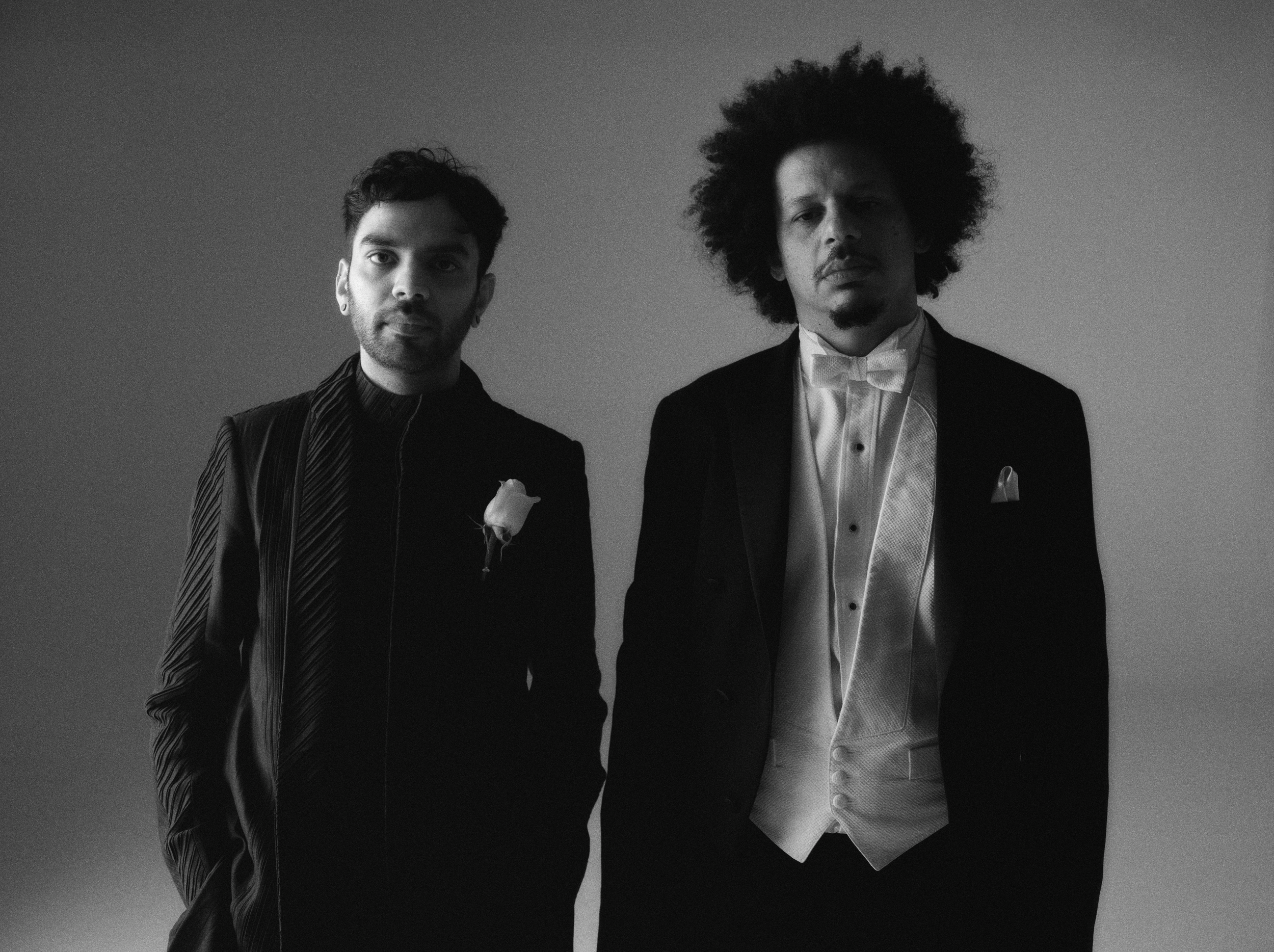
Eric André had a Berklee degree, a pile of voice memos, and no script. Prateek Rajagopal had the range to meet him there. What they made had nothing to do with film.
Words by Owen Danoff
Film Scores for Films That Don’t Exist is difficult to define. A comedian conceived it, but it is not a comedy album. It was co-created by a film composer, but was written without a story, script, or visuals. It was released by BLARF, a musical project last active in 2019 and known for songs like “Badass Bullshirt Benjamin Buttons Butthole Assassin” and “I Worship Satan.”
The album may best be summed up in two ways: as a labor of love for the intricacies of film music, and as a small revolution against that very concept, not to mention four hundred years of classical tradition.
First imagined by actor, writer, and comedian Eric André, Film Scores for Films That Don’t Exist is a collection of eight pieces that make a fantastic case for the idea that genre is dead. String sections dance frenetically on “What’s For Dinner” while lush synthetic soundscapes evolve and grow on “Stars Without Light.” In fact, the album boasts such a range of tones and styles that it is difficult to imagine that a single person, even one who studied composition and upright bass at Berklee College of Music and has released experimental albums in the past, would want to do it all themselves.
Enter composer Prateek Rajagopal, the other half of Film Scores for Films That Don’t Exist. Rajagopal, who grew up between Oman and India, admits to being a fan of André long before the two crossed paths. “I was in India for university,” Rajagopal shared over Zoom from his home in Los Angeles, “and my best buddy [was] like, ‘Have you heard of this guy Eric André? He’s funny as hell.’”
Rajagopal was deep in it at the time: working at a bank by day, touring worldwide with India's premier death metal export Gutslit, composing and performing with progressive metal band The Minerva Conduct alongside ex-Animals As Leaders and Entheos drummer Navene Koperweis, and leading progressive rock solo outfit HOIA, which featured Colin Edwin of Porcupine Tree and Steven Wilson on bass. He had also begun writing ad music and jingles in India. André's comedy, then, was pure release. "We'd watch his shit and just laugh," he admitted. "We'd be like, 'This guy is nuts,' in the best way possible."
"There's something about music where, if it's your first love, it never quite leaves.”
— Prateek Rajagopal
After university, Rajagopal came to the United States to study film scoring at USC, which set him on the path to not only working with André but also contributing to film and TV projects such as The Mandalorian, Eddington, HIM, and Trolls, amongst others. "I got connected with Joe Shirley, [who] scored Eric's movie Bad Trip [with] Ludwig Göransson," Rajagopal said.
Shirley, as it happens, had been in contact with André about a new musical project that The Righteous Gemstones and The Eric André Show actor wanted to create. “Joe was like, ‘I don’t have time for this shit. I’m scoring Star Wars’,” Rajagopal laughed, “[but] he was like, ‘But there’s this guy. You should meet him.’”
“Eric and I got connected, and we hit it off,” Rajagopal explained, adding, “He’s incredibly creative … he’s very much a musician. He studied counterpoint and conducting [at Berklee] … and graduated with a really high GPA.”
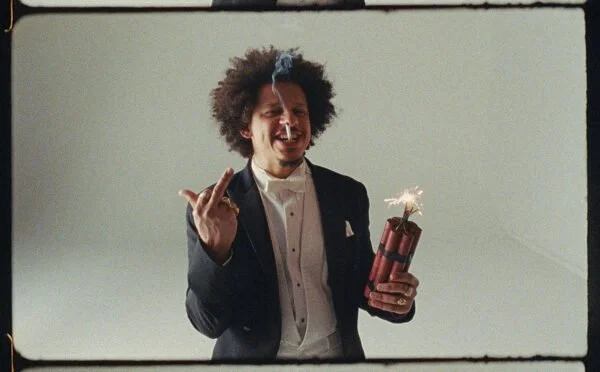
According to Rajagopal, André was first bitten by the film scoring bug during Bad Trip. “I think when Joe [Shirley] and Ludwig scored his movie, he was very fascinated by the process, and he was like, ‘Wait. I can do this,’” the composer said. André then started recording rough memos of song germs, some of which he eventually sent to Rajagopal.
“I would just send voice memos of various melodies and potentially instrumentation,” André revealed over e-mail, “and Prateek would help me flesh out the ideas with MIDI demos.”
“It would be, like, the seed of an idea,” Rajagopal confirmed, “I would listen to it, think about it, take it from there, and flesh out a massive suite of music.”
Rajagopal’s suites and embellishments became invitations for André to iterate, he revealed: “He would get into the studio, chop [what I had sent] up, mix and match, remove stuff, [and] make it better.” That back-and-forth continued, with both composers honing their ideas with obsessive dedication. “Sometimes we would take, like, 30 minutes to figure out two seconds of a piece.”
“I would never have finished without him,” André said of his collaborator. “Prateek’s musical taste is so vast and versatile. He’s a machine. A total wiz. He knows every genre.”
It’s safe to say Eric André didn’t take a traditional route to composition, and he may have unwittingly found a kindred spirit in Rajagopal. “I wasn’t one of the people who grew up watching Jurassic Park, going, ‘Wow, I want to become a film composer,” Rajagopal said. “I’ve just always loved music. Whatever medium it’s attached to, to me, it’s all a similar process.”
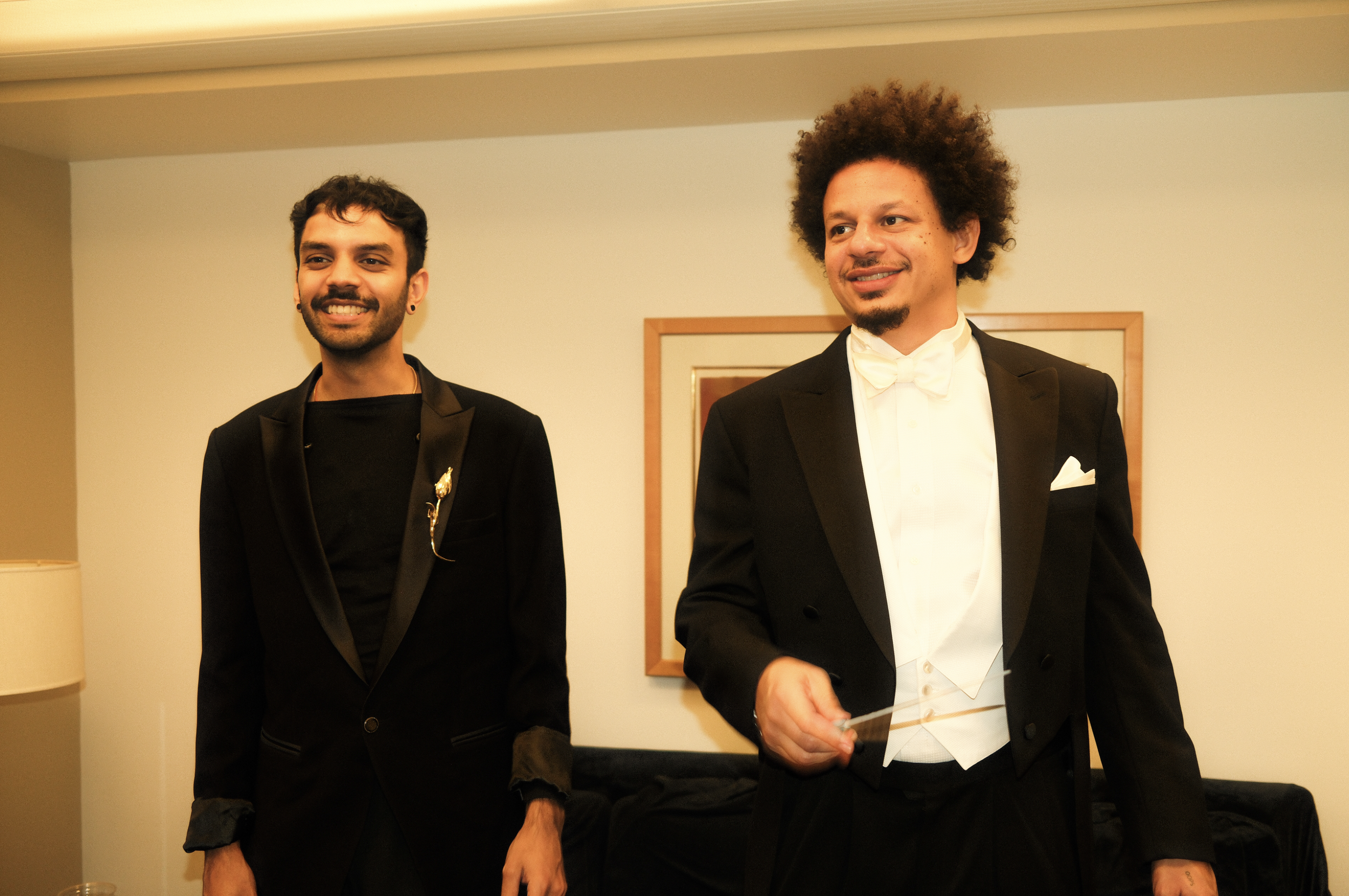
Fittingly, Film Scores for Films That Don’t Exist goes where passion, not picture, dictates. “It was very experimental,” Rajagopal said when describing their process, which generally only saw the musicians reaching for references after initial ideas were created. Then, they could lean into those references. The album’s first track, “The Final Shootout,” evokes Ennio Morricone with lonely whistles and evocative strings; “[Eric] used to listen to a lot of Italian film scores,” Rajagopal explained.
“I love that Ennio Morricone B-sides record that Ipecac put out,” André confirmed, “And Luis Bacalov.”
Both André and Rajagopal were hands-on in recording the music. Rajagopal took the lead on programming, and played guitars, synths, and production, while André played double bass on most of the album’s songs: “I used to be much better at bass when I was 19 years old and didn’t have to work all day and earn money,” André said, “but it definitely scratched the itch.” It’s easy to imagine that the 19-year-old student and upright bassist André would be thrilled that his decision to study at Berklee would one day result in an album like Film Scores for Films That Don’t Exist, even if present-day André is less thrilled about aspects of his Berklee experience in retrospect. “I wish Berklee gave me a scholarship,” André said. “I worked so hard there, and they kept all my money. I’m clearly bitter about it,” he laughed.
"The live show really proved that this concept is bigger than anyone thought it was.”
— Prateek Rajagopal
Additionally, the pair spent four days in Budapest working with string and brass sections for the album’s biggest orchestral moments. Soloists on the album include percussionist MB Gordy, woodwind player Ashley Jarmack, and drummers Brian Chippendale (on “Run For Your Death”) and Navene Koperweis (on “What’s For Dinner”).
Film Scores for Films That Don’t Exist is the kind of album that exists only because of the passion of its creators. It doesn’t speak to the established brands of Eric André or the label that released it–the traditionally hip-hop-forward Stones Throw Records. “There was no interference from anyone,” Rajagopal revealed, “It was just me and him making music.” It’s also the kind of project that many might expect to be a one-off. Even Rajagopal tempered his expectations coming on board; “I was like, ‘Okay, this is going to be, number one, a calling card.’”
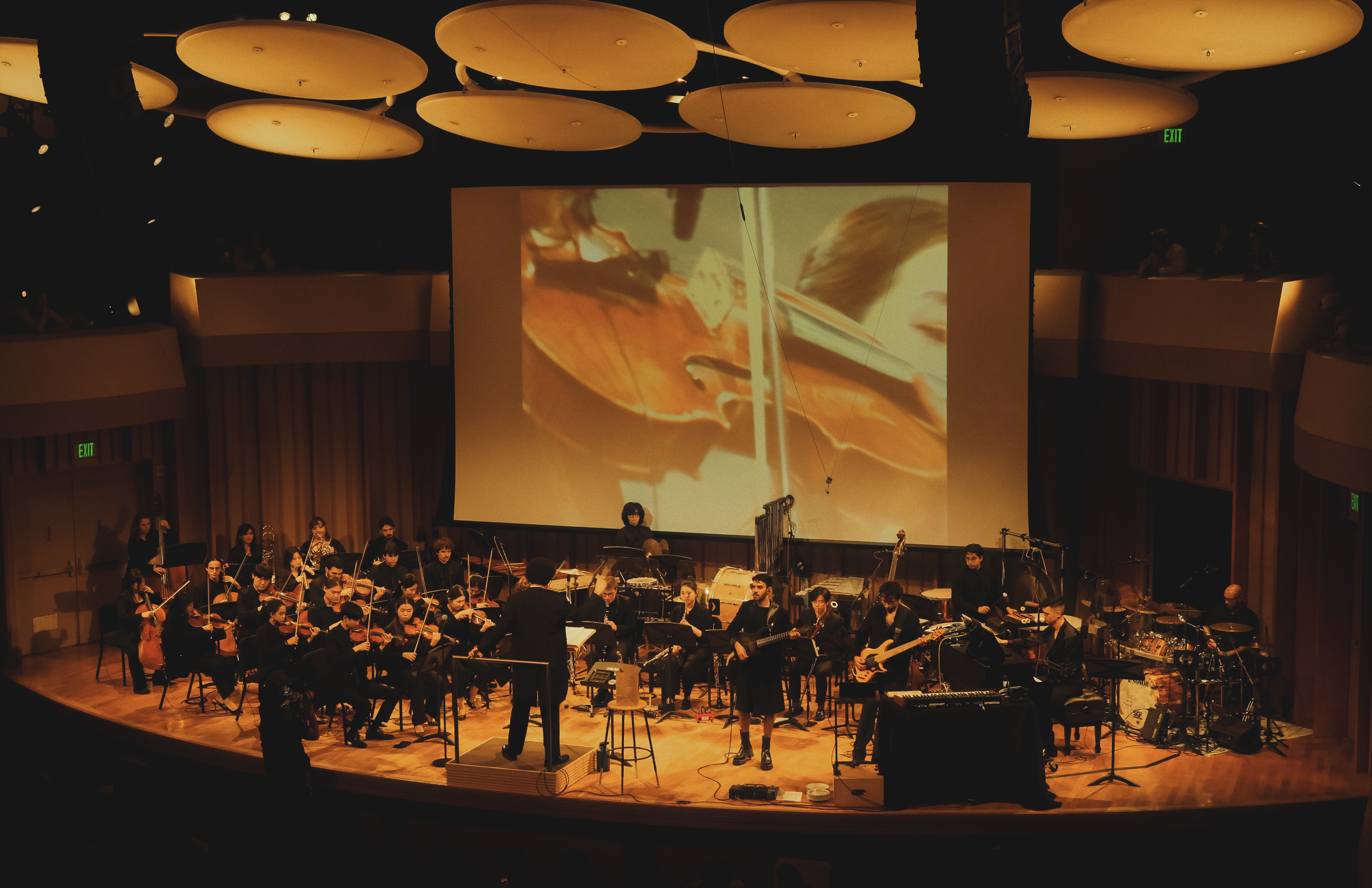
Then, a live performance of the album at Zipper Hall in Los Angeles opened Rajagopal’s eyes to what could be. “We had to do that to promote this record so the label could hopefully make some money,” the composer said, before calling the performance of the album “an eye-opening experience for us.”
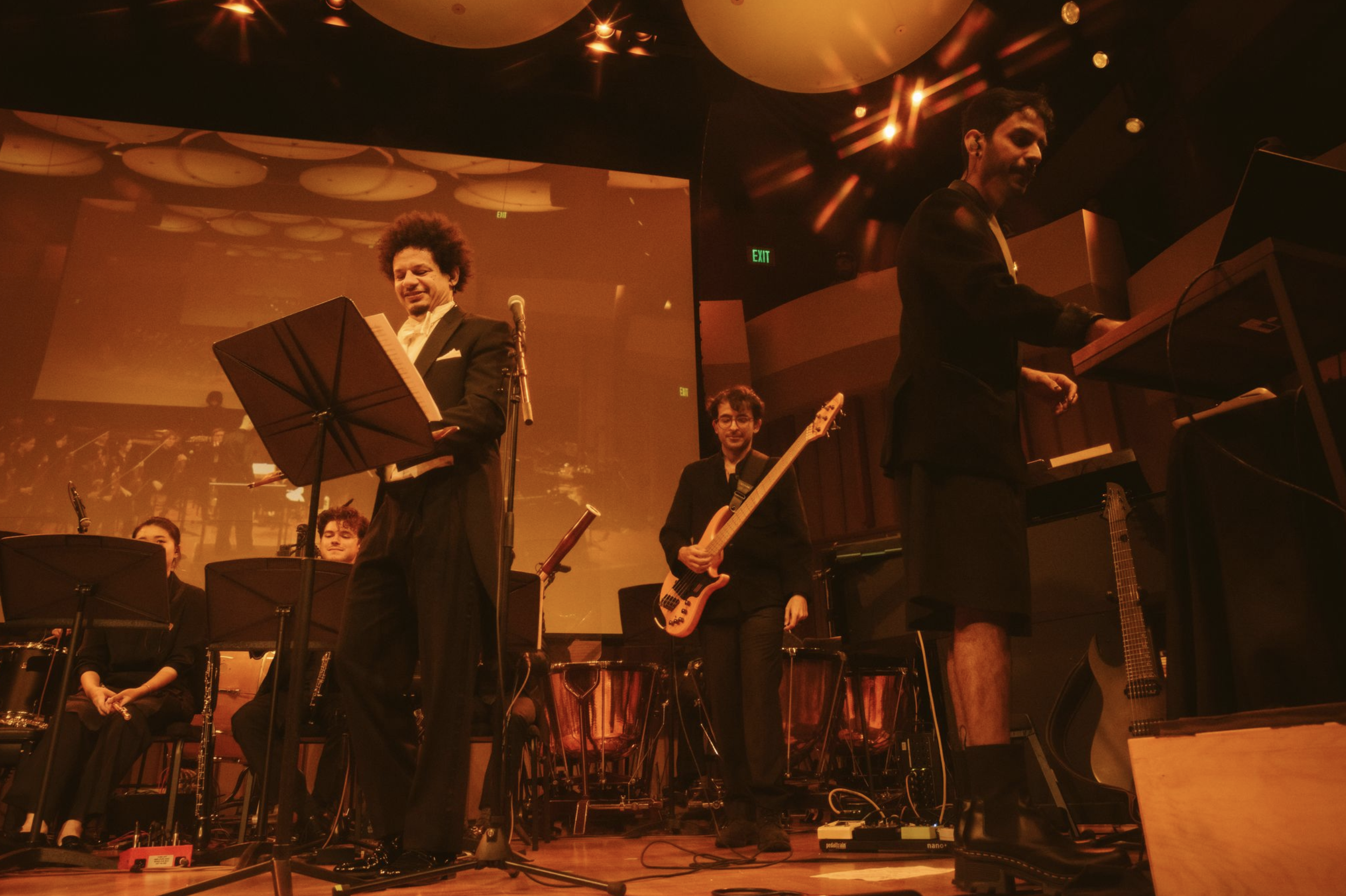
Based on Rajagopal’s account, the performance of Film Scores for Films That Don’t Exist showcased a near-perfect blend of André’s comedic and musical abilities. “Eric was drinking beers,” Rajagopal said. “He was feeding beers to the audience members. He was smashing plates into this garbage can. It became performance art.”
As bizarre as André’s on-stage antics sound, the comedian assured that they–or at least the tone of his performance–was very deliberate. “We would brainstorm every rehearsal,” he said, adding, “It’s much more fun to rehearse with people than by yourself. I would HATE practising my scales and arpeggios growing up, [and] memorizing lines is such a drag.”
That rehearsal process allowed Rajagopal and André to perform alchemy on the stage. “The music is really serious, and you’ve got the best musicians playing super tight, and then you have Eric just staring at an audience member, and people are just laughing,” Rajagopal recounted, “Then, the moment he was back on stage and back to conducting, they were back to the music. And by the end of the show, people were crying. They’d gone through a whole whirlwind of emotions.”
"I would never have finished without him. Prateek's musical taste is so vast and versatile. He's a machine. A total wiz. He knows every genre."
– Eric André
No plans have been revealed for another live performance of Film Scores for Films That Don’t Exist, but Rajagopal is hopeful to share the stage with André at least once more. “Let’s see where it goes from here,” he said. Plus, now that the duo of Rajagopal and André has proved their ability, there is the chance that they will find themselves scoring a film that does exist.
“If we get a call, we’ll figure it out,” Rajagopal said. “Say yes and figure it out. That’s our motto.” When asked what his composing future looked like, André himself was hopeful: “I would love to keep it going.”
Film Scores for Films That Don’t Exist is out now via Stones Throw Records.
Photographs Jeff Leeds Cohn & Carianne Older