5 Questions with the Chan Brothers
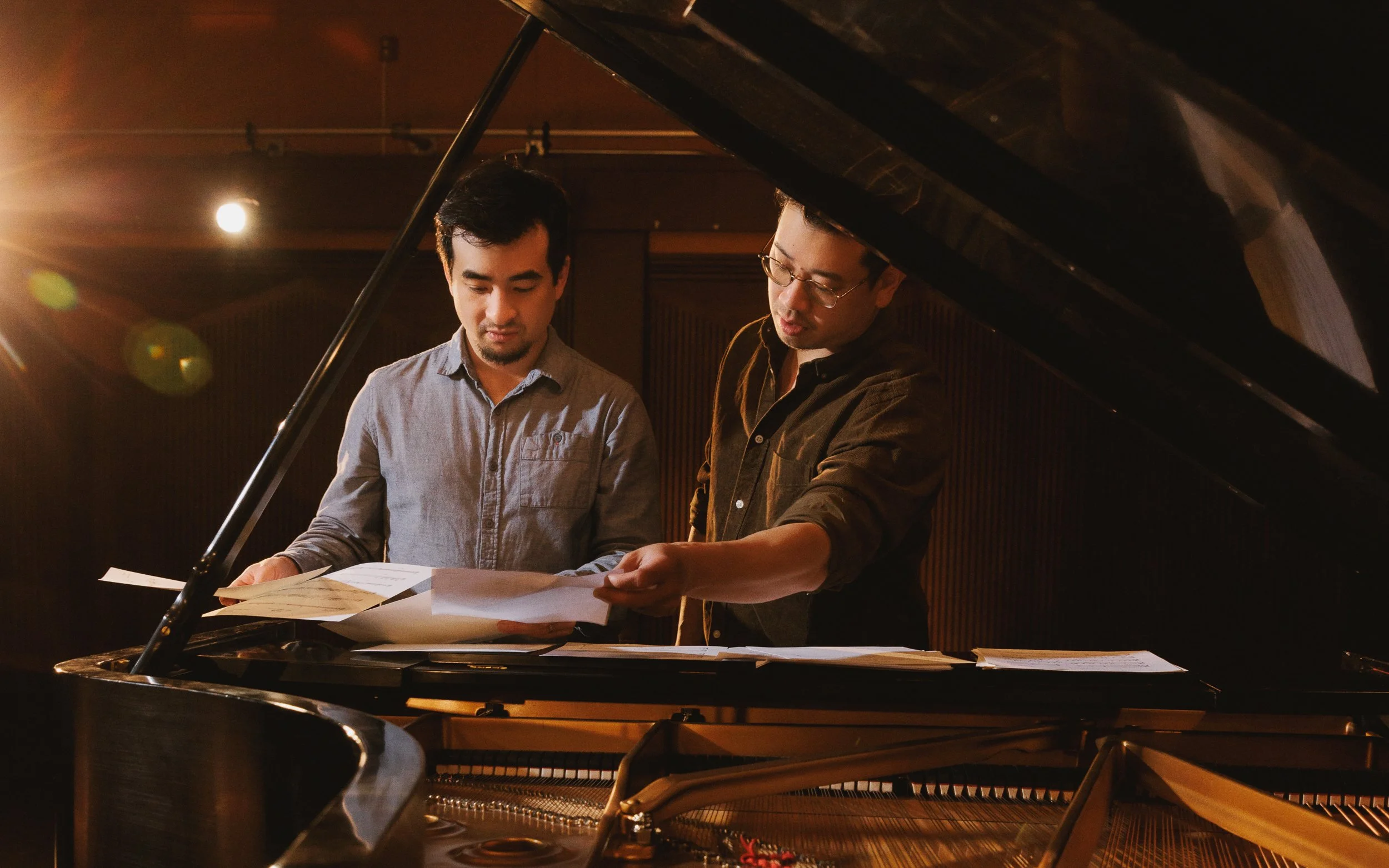
The Vancouver-based composing duo on genre-jumping, cultural roots, and the music that costs something to make.
Words by The Blank Mag
Caleb and Brian Chan have never made things easy for themselves. The Vancouver-based brothers, raised between Hong Kong and Canada, move between children’s animation and Sam Raimi horror, then to intimate documentary and full orchestral features without breaking stride. Classically trained but indie-spirited, they write with whatever the story demands.
2024 brought a SOCAN Breakout Composer of the Year Award, multiple Leo Awards, and back-to-back Canadian Screen Award nominations. We caught up with Caleb and Brian to talk genre, creative blocks, and what it means to score your own culture.
You’ve scored everything from children’s entertainment to darker dramas and thrillers – what excites you most about jumping between such different worlds?
C: It’s given us great opportunities to see the world through different lenses and find a bit of ourselves in all of them. One of my favourite moments was years ago when we came off a cute preschool show immediately into Sam Raimi’s horror anthology series, 50 States of Fright. It was a lot of fun to indulge in the stark differences but also notice the strange similarities. I don’t think those things would have been as apparent otherwise, and it helped distill the craft to grounded tenets while still feeling expansive and infinite. Since having kids, it has changed the perspective of scoring both shows for them and stories for us as well. Jumping from one to another is just like real life and keeps me honest in many ways.
B: As kids, we were always excited by the next sick melodic turn in a song, or weird intricate harmony, or gospel chop fill, and genre boxes didn’t contain that. So uncovering the particulars that make each unique world speak is what’s most satisfying and echoes the thrill of how we loved to discover music when we were younger. It can also be hilarious to superimpose cues from one project onto another. When it comes to actual writing, the sandbox parameters themselves become a source of excitement for dialing in our intuition and creating a tailored vocabulary. And it’s just more fun to play in distinctly different playgrounds.
“Every time I write for a live ensemble, the child in me is reliving a core memory of playing in them in the distant past.”
– Caleb Chan
When you’re deep in a big show or long-running series, how do you keep the music feeling fresh without burning out creatively?
C: Listening back to older cues and noticing the sonic evolution throughout a series is sort of like looking at old photos of yourself. We try our best to capture the spirit of the show from the first moment, but there’s usually a surprising amount of freedom to play around it. Some of that comes down to production elements, but in thematic writing specifically, reinterpreting melodies in new ways down the road is always a treat. For a show like Boston Blue, we know we shouldn’t reinvent the wheel every episode, but we might pick a handful of cues in each to make small advances and see which ideas stick over time. As a shoutout to our lovely music editors, sometimes old material find their way into new cuts in fascinating ways. Mentally, a bit of grace also goes a long way. Not every cue in a 20-episode season is going to be a banger and that’s mostly okay.
B: It’s probably akin somewhat to fog of war in a game where you explore and stretch the borders of the world at the same time. Sometimes, we’ll ask for hints of the larger story trajectory, in particular when it’s early on in a new season and we don’t have materials to look ahead yet. And sometimes you get the sense the showrunners want to push things in a certain direction that can inform subtle nudges instrumentally etc. I’m beginning to appreciate bolder sonic changes as it relates to the story and theme expansions even melodically. In our procedural work, we’ve had to figure out how to make things more propulsive over time and thread the series theme with a newly introduced villain theme.
What’s a recent project where you felt like you levelled up in some way, whether creatively, technically, or personally?
B: This past year we had the opportunity to score a doc “Spring After Spring” by Jon Chiang about the legacy of Maria Mimi Ho, a pioneer who brought Chinese dance to our hometown lunar new year parade. Her three surviving daughters tell her story beautifully and talk about what it’s like to run a dance academy that still performs annually at the parade. Attending the parade is a tradition for our families, and we go every year because it rules, and we also have a sister, so the connection to the project was layered, and it resonated as semi third culture kids with roots in the same city. To have a film relate on so many levels felt like literal levelling up.
Musically, the project allowed us to work with traditional Chinese musicians - shoutout to Geling Jiang on Guzheng and Yun Song on Erhu. We wrote thematically, and what came out was a hybrid of what could be considered a more idiomatically Chinese melody interwoven with more modern chamber orchestration and synths. Conceptually, we kept a lot of it in groups of threes to represent the three sisters.
C: We had a rewarding experience working with Toei Animation on the upcoming feature Hypergalactic, scored for a large orchestra, which is always as difficult as it is gratifying. Every time I write for a live ensemble, the child in me is reliving a core memory of playing in them in the distant past. That perspective creates deep hope that our music will be genuinely enjoyable for the players, especially knowing we’d be recording as a full tutti ensemble. We were also fortunate to bring in some unique instruments such as the Chinese suona, Japanese koto, and a funky modern invention called the daxophone. Brent, our brother-in-law, helped us build one and it’s now immortalised in the score.
Early in the process, I hit a fairly significant creative block for a couple of weeks due to some stressors. It thankfully eased after a moment of clarity on a nature walk one day, and I don’t think I’ll soon underestimate the value of a forced break.
What’s the most unexpected source of musical inspiration you’ve ever pulled from, something totally not “film score”?
B: We have an old Yamaha keyboard that my kids love to hammer on post-dinner, so more recently, that has been a source of odd inspiration. There is serious magic in completely untrained fingers for awkward, amazing intervals. Also, credit to whoever programmed the factory midi demos because they are decent and only somewhat annoying after a long interpretive dance session. There may or may not be snippets of those too in past cues.
C: I’m always amazed at how stand-up comedians pace their delivery for the greatest impact. There’s a lot of musicality in structuring a good joke - the rhythm, micro-adjustments to timing, reaction to the audience, and everyone has their own way about it. That natural intuition is what I try to work on in my own scoring so the music feels inevitable as it interacts with the picture and story. I used to fall asleep to stand-up clips, so hopefully some of that has seeped into my psyche while I’m unconscious.
Looking ahead, what kinds of stories, genres, or collaborations are you most excited to explore next?
C: I would love to invest more in features and stylistically do something I haven’t tried before. I wish I could articulate that more, but I’m not even sure what it really means. Maybe the uncertainty is part of the excitement for future collaborations. In recent years, I’ve had the privilege of also writing for a couple of indie films with really beautiful stories, and both have challenged my writing in ways that felt new, even if the instrumentation was familiar. Balancing those more intimate projects with the larger-scale ones seems like it will fulfil multiple creative ambitions.
B: I’ve always enjoyed working with real musicians, so I would like to do more and more of that. Prior to composing, I practically lived in collaborative recording studios, so while writing in siloed spaces can be fun and more efficient creatively, there’s always the itch to merge the two for the right project. It’d be fun to try a quirky dystopian sci-fi drama or a slow-burning heist one day.